Fursuit guide
Fursuit ref sheets: what your fursuit maker needs to see
By My Furry Art · Published 25 November 2026
In short
- A fursuit maker builds from your reference sheet, so anything it doesn't show gets guessed.
- Makers usually ask for a front, a back and a side view, in flat colours with no shading.
- Add close-ups of the parts that get built separately: the head, the paws, the feet and the tail.
- Check your maker's rules before you order a sheet. Some only work from their own concept art.
A fursuit is the most expensive piece of your fursona you'll ever buy, and it's built from a drawing. Your maker can't ask the character what the back of its legs look like. Whatever your reference sheet doesn't show, they have to guess.
A fursuit ref sheet is a normal reference sheet with that job in mind: every side shown, every colour exact, nothing left to interpretation.
What a fursuit maker needs to see
Every maker has their own rules, and you should read them first. These are the things almost all of them ask for.
- A front view and a back view, at the least. Most makers want a side view too. A suit is a 3D object, and markings have to meet up around the body.
- Flat colours, with no shading. Shading changes how a colour looks, and your maker matches fur to the colours on the sheet. Ask your artist for a flat-colour version as well as the finished, shaded one.
- A colour palette. One swatch for every colour on the character, so each fur can be matched exactly.
- Markings mapped on every view. Where a stripe starts on the front, it has to continue on the side and finish on the back.
- The head, up close. Eye colour and shape, the inside of the ears, the nose, and any hair.
- The mouth. If your suit will have an open mouth, show the teeth and the tongue and their colours.
- Paws and feet. Paw pad shape and colour, and claws if your sona has them.
- The tail, from more than one side if the markings differ.
- The leg shape. Say whether you want plantigrade (straight) or digitigrade (animal-shaped) legs, and have the sheet drawn that way.
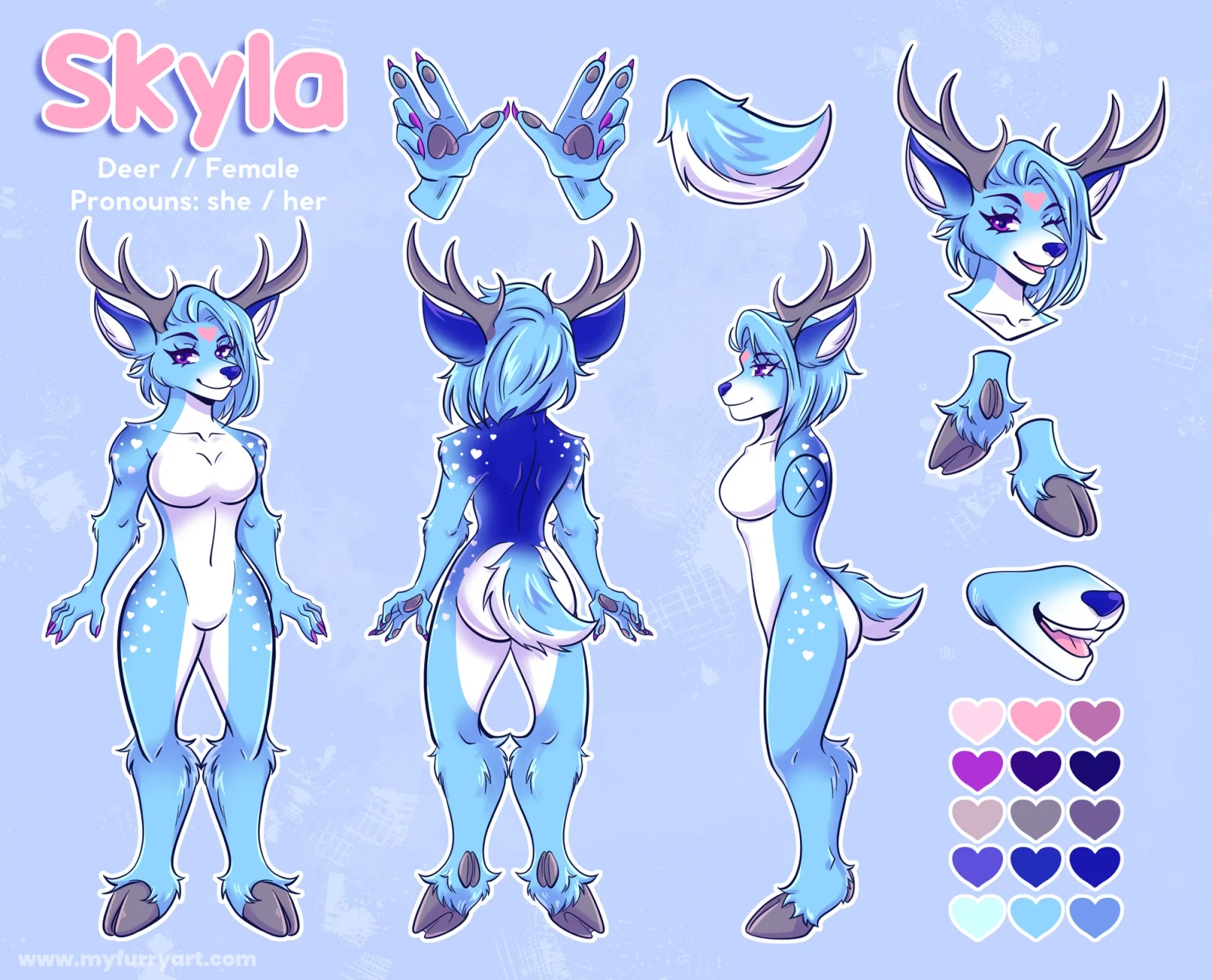
This sheet has every view and close-up on the list: three views, the head, an open mouth, the hands, the hooves and the tail. You're looking at the finished, shaded version. The flat-colour version that comes with it is the one a maker matches fur to.
Design choices that make a suit easier to build
A drawing can do things that fur can't. If a fursuit is in your future, it's worth thinking about while your sona is still on paper.
- Clean blocks of colour are easier to build than soft gradients, which usually have to be airbrushed.
- Fewer, larger markings are easier than dozens of tiny ones. Every spot is a piece of fur that gets cut and sewn.
- Markings have to work in 3D. A pattern that looks right from the front should still make sense when it wraps round an arm or a leg.
- Clothes hide the body. If your sona wears an outfit, get at least one set of views without it.
None of this means your sona has to be simple. It means your maker should be able to see exactly what they're being asked to build, and tell you what it involves.
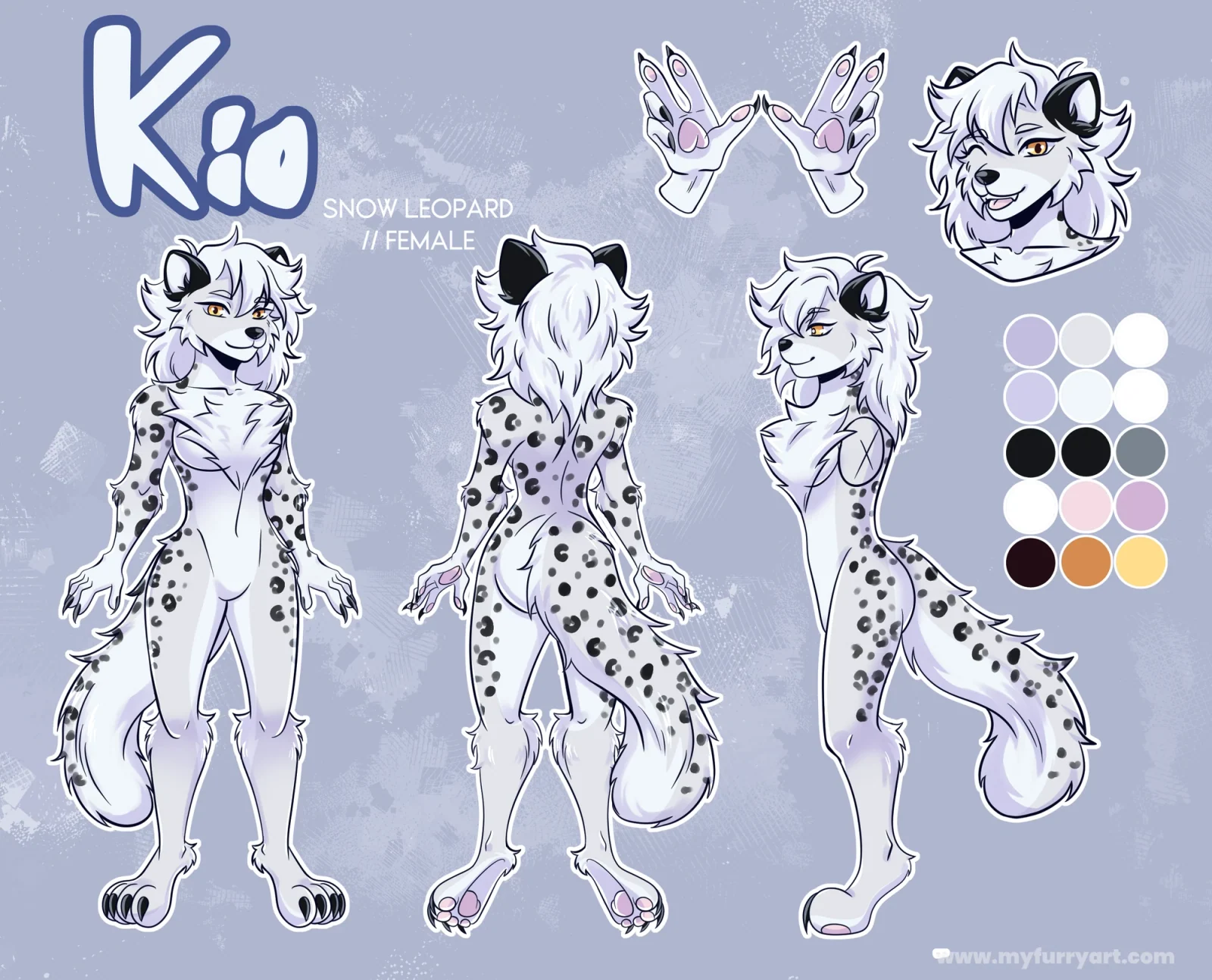
Spots are a good example. Here they're mapped on the front, the back and the side, so a maker can count them and place them.
Fursuit ref sheet examples
These are sheets we've drawn with three views or more.
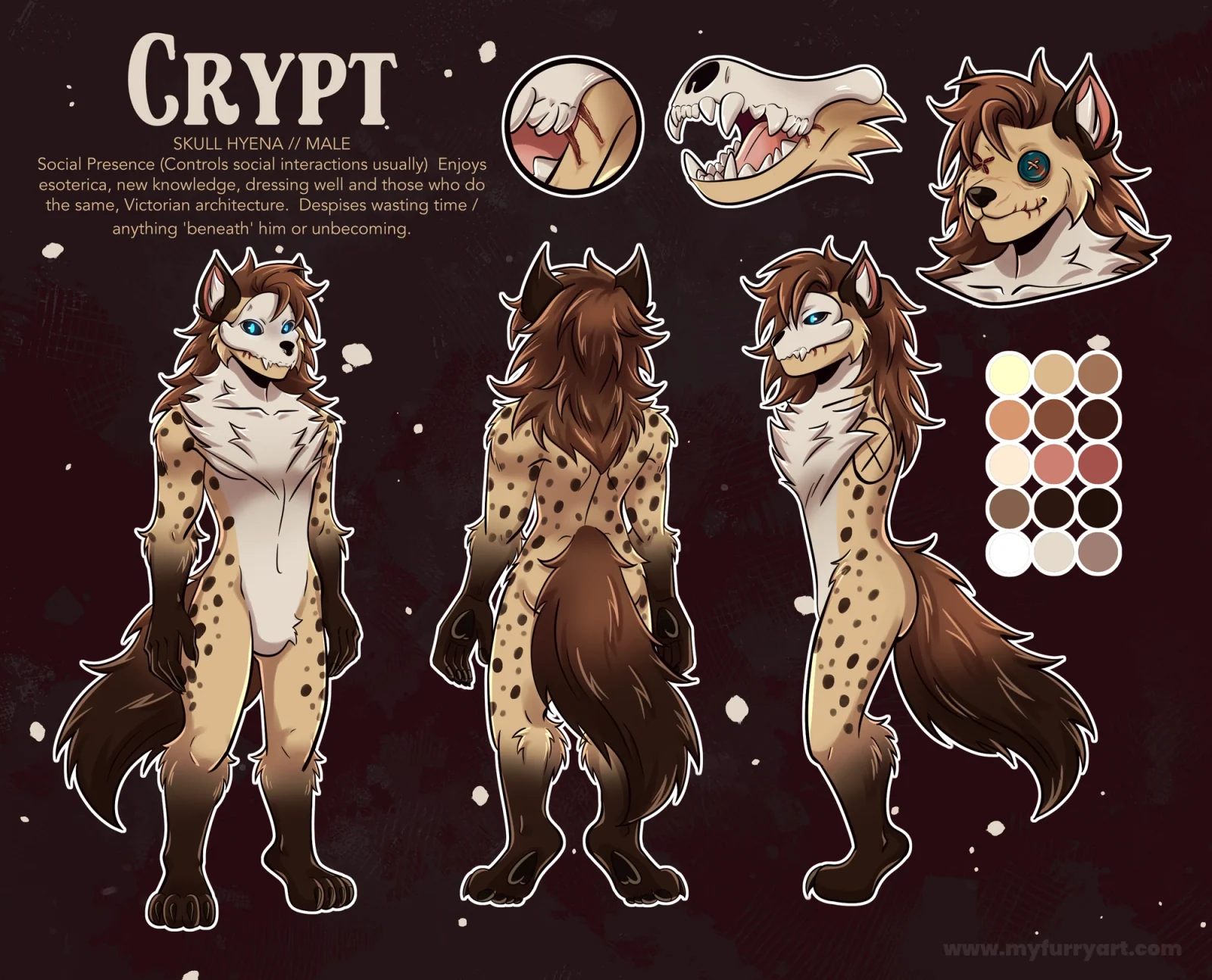
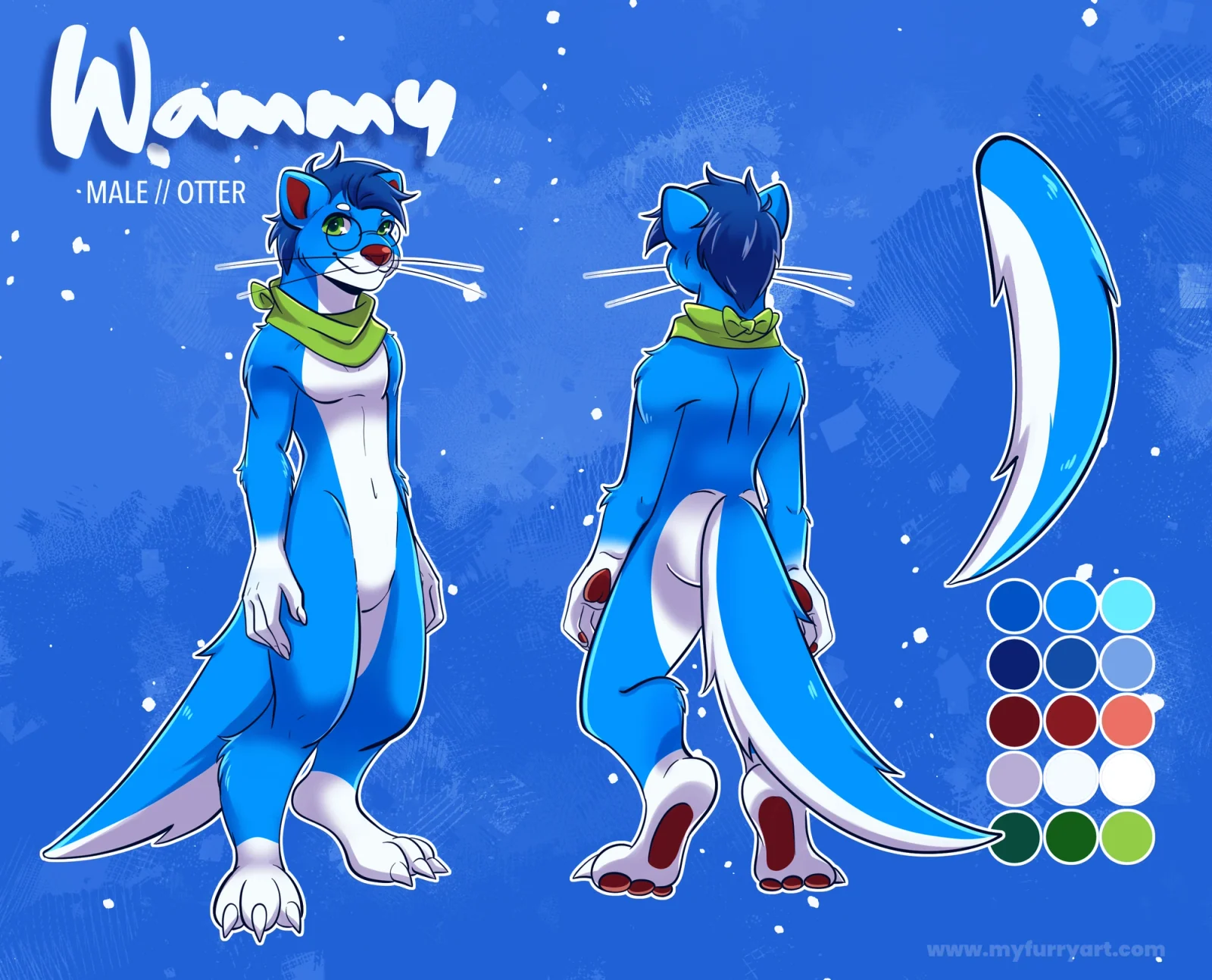
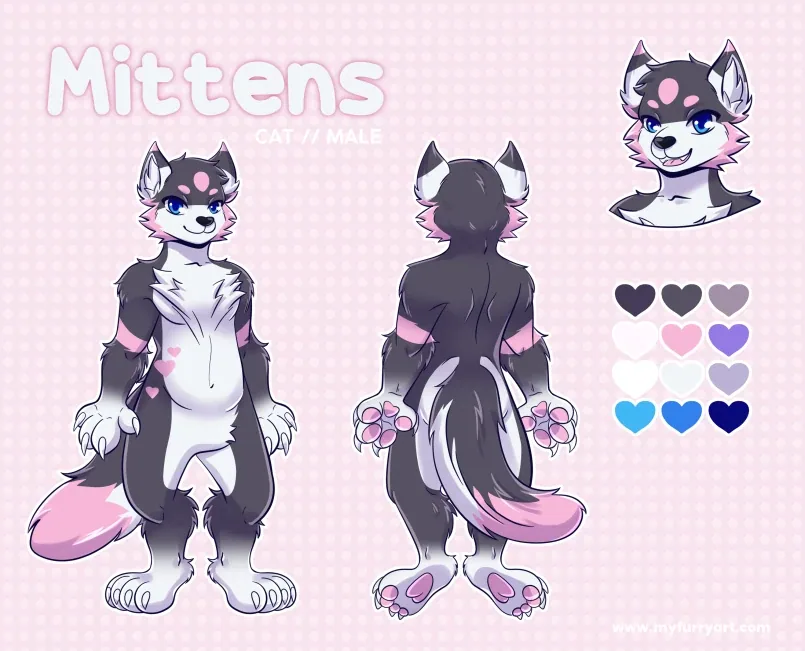
Front, back and side, a headshot, and a close-up of the skull, which is the part a maker would have the most questions about. From the client's review: "the hunt for makers has begun".
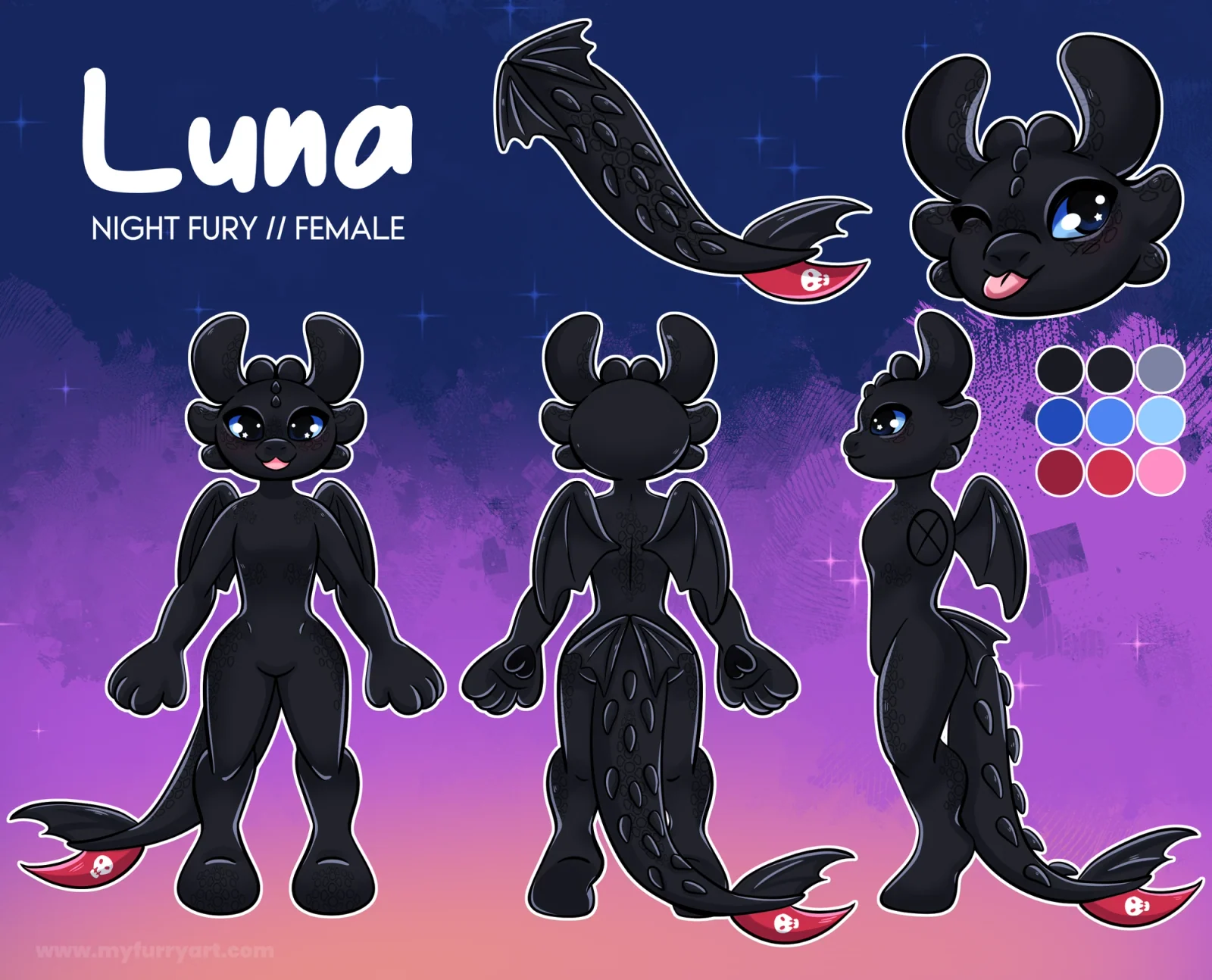
Wings and a finned tail look completely different from the side, so the third view is doing real work. The tail has its own close-up.
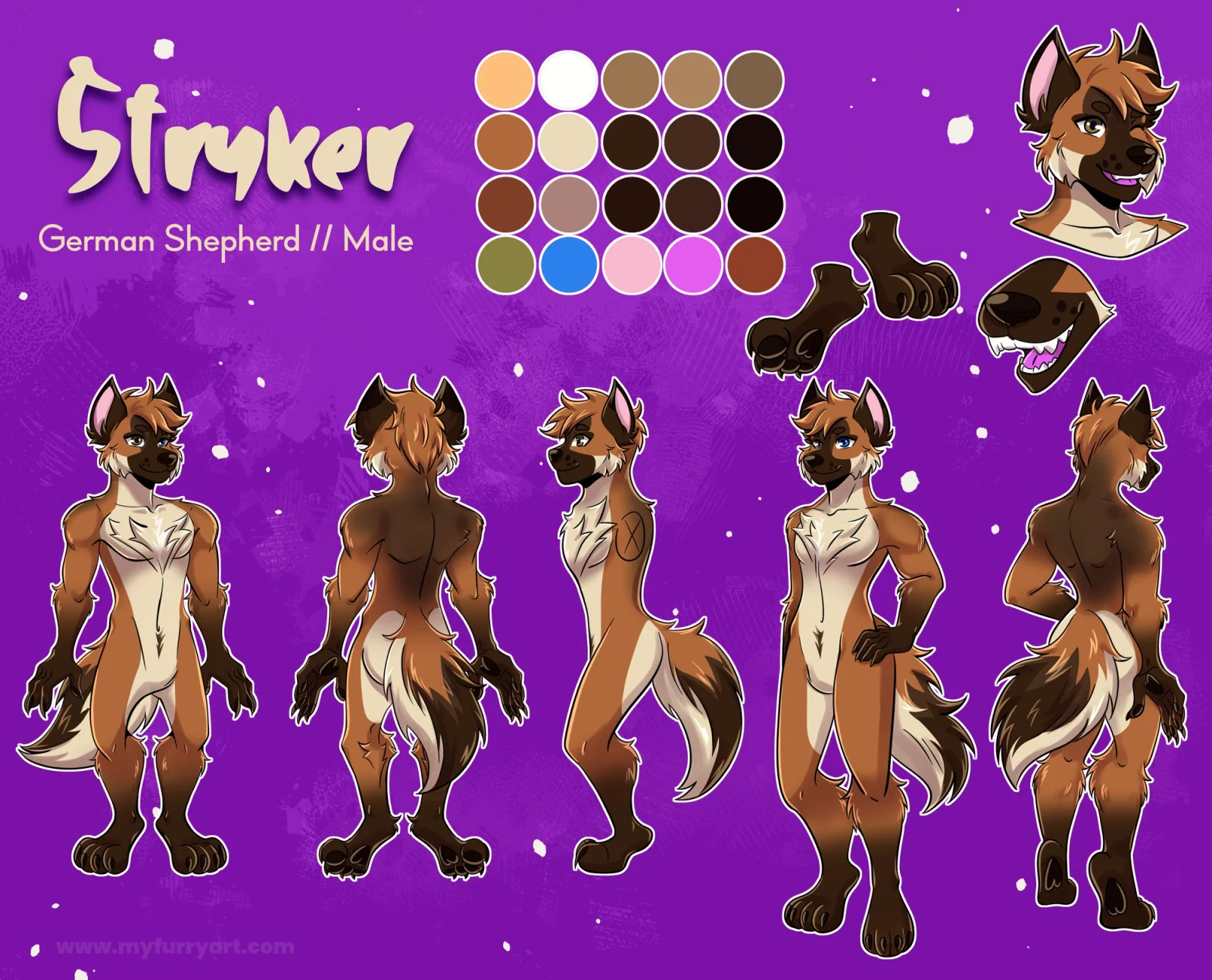
Five full-body poses, with a headshot, the feet and an open mouth. More than most makers need, and nothing left to guess.
We've put more in our 28 ref sheet examples.
A sheet for a head, or for a partial suit
Not every suit is a full suit. A partial is usually a head, hand paws, feet and a tail. For that, your maker still needs the colours and markings of the whole character, but the close-ups matter most: the head from the front and the side, the mouth, the paws and the tail.
If you only want a head for now, get the full sheet anyway. It costs far less than a suit, and you'll want the rest of the character to match later.
Can I use a free base or a template?
You can, if your maker accepts it. A base is a blank outline that you colour in yourself, and many are free. It's a fair way to start, with two limits. A base has one body and one head shape, so it can't show the parts of your sona that make it different. And you need to follow the base artist's rules on credit and use.
A sheet drawn for your character shows its own face, its own build and its own markings, which is what a maker is trying to match.
Before you commission the sheet
- Pick your maker first, if you can, and read what they want from a reference sheet.
- Check whether they accept outside artwork. Some makers only work from concept art drawn by their own artists.
- Ask how many views they need, and whether they want a flat-colour version.
- Tell your artist it's for a fursuit. It changes what goes on the sheet.
Our Fursuit-Ready reference sheets
We don't make fursuits: everything we make is digital art. What we draw is the sheet your maker works from.
Our Fursuit-Ready reference sheet has three poses and two extras, such as a headshot and paw pads. Every reference sheet comes with a colour palette and a flat-colour version of the finished sheet. You can pick the poses and extras yourself, and add more later. Reference sheets start at $135, and the order form shows your total as you pick.
You don't need a finished design. A description is enough, and the sketch stage repeats until your sona looks exactly right. In the order form, tell us the sheet is for a fursuit.
Questions people ask
Do I need a ref sheet to commission a fursuit?
In practice, yes. It's very difficult to commission a fursuit without one, because the maker needs to see the character from every side before they can quote or build.
How many views does a fursuit ref sheet need?
A front and a back at the least. Most makers also ask for a side view, and close-ups of the head, paws and tail help. Your maker's own rules come first.
Does a fursuit ref sheet have to be unshaded?
Makers usually ask for flat colours, because shading makes colours harder to match to fur. Our reference sheets come with a flat-colour version as well as the finished, shaded one.
How much does a fursuit ref sheet cost?
It depends on the artist and on how much is on it. Our reference sheets start at $135, and the Fursuit-Ready size has three poses and two extras. Unlimited revisions and a money-back guarantee are included.
Can I add to a ref sheet I already have from you?
Yes. We keep the source files, so we can add poses and extras to a sheet we drew for you.